Bear market — directional engines are silent; carry and 4H momentum take over
Free Crypto Signals — 08/10/2026
Crypto signals that go quiet when there is nothing worth buying. Five engines measured over six years, each validated against a random draw of the same density. When the market does not cooperate, the channel says so instead of inventing trades. Free on Telegram, no signup.
No human involvement, no opinions, no “analyst”. A program reads prices, applies rules fixed in advance, and publishes — or does not.
The market is ranked
Every day, 40 cryptos are compared against each other. The program is not looking for a secret pattern: it checks which ones are genuinely strongest right now.
The regime is checked
If Bitcoin closes below its 200-day average, the engines that buy strength stop. That happens 41% of the time, and it is what avoids the -70% years.
You get the signal
Entry, stop, three milestones, and the exit date. On Telegram, the moment it is detected. Every signal names the engine it came from.
The outcome is published
Win or lose, the signal is closed publicly on the channel and archived on this site. Nothing is removed afterwards.
Five signal engines, each validated against a random control: relative strength, channel breakout, volatility expansion, funding carry, and 4-hour momentum. The last two keep producing when the market falls. Updated daily.
Three families buy an uptrend: entry, a deliberately wide 4x ATR stop (disaster protection, not a management tool), tracking milestones at 4x, 8x and 12x ATR, and a time-based exit — the date closes the position, not a price target. The fourth one, the funding carry, does not bet on price at all: it opens two opposite legs and closes on a date. It therefore has no stop loss and no take profit, and that is normal.
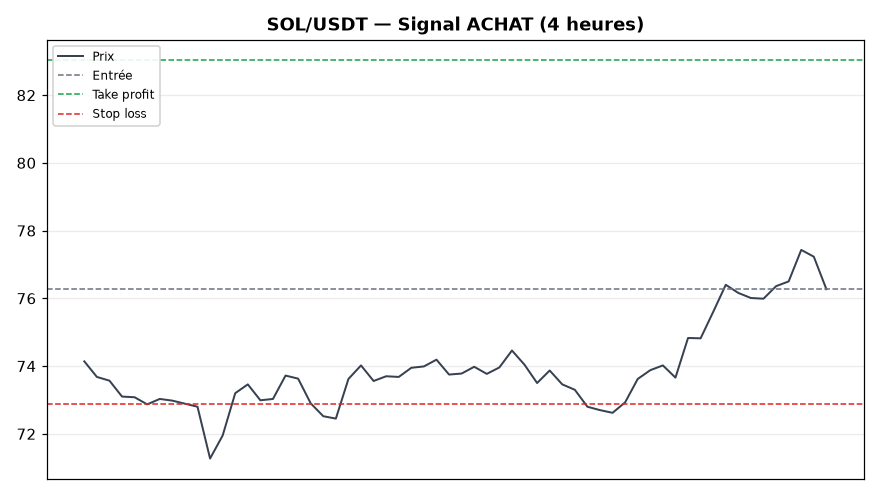
SOL/USDTBUY
Entry76.27Stop loss72.88Take profit83.05
On SOL/USDT, the same ranking principle as relative strength, measured on 4-hour candles: SOL/USDT ranked among the strongest cryptos of the moment. This engine only fires while the market is bearish — the window where the system's other strategies stay silent. Entry near 76.27, stop loss at 72.88 (-4.4%), main target at 83.05 (+8.9%), exit after 3 days. This engine is under observation: its edge measures positive in three years out of four, but declining in the most recent one.
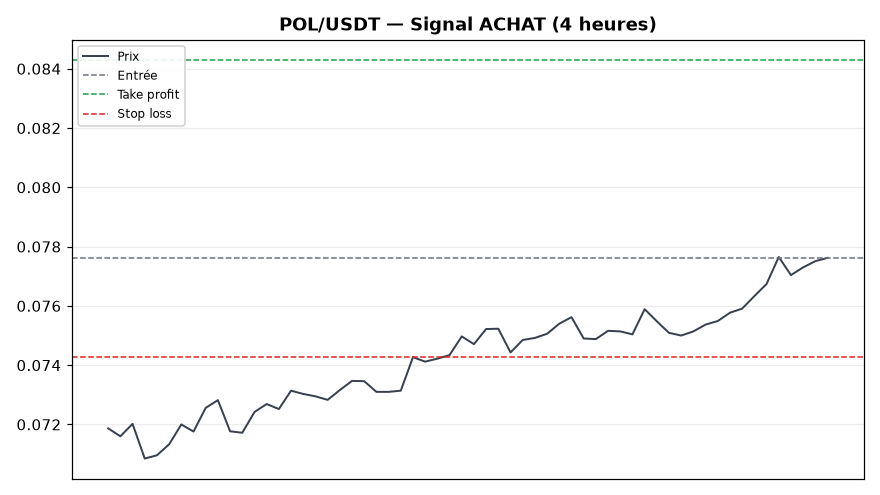
POL/USDTBUY
Entry0.077620Stop loss0.074275Take profit0.084309
On POL/USDT, the same ranking principle as relative strength, measured on 4-hour candles: POL/USDT ranked among the strongest cryptos of the moment. This engine only fires while the market is bearish — the window where the system's other strategies stay silent. Entry near 0.077620, stop loss at 0.074275 (-4.3%), main target at 0.084309 (+8.6%), exit after 3 days. This engine is under observation: its edge measures positive in three years out of four, but declining in the most recent one.
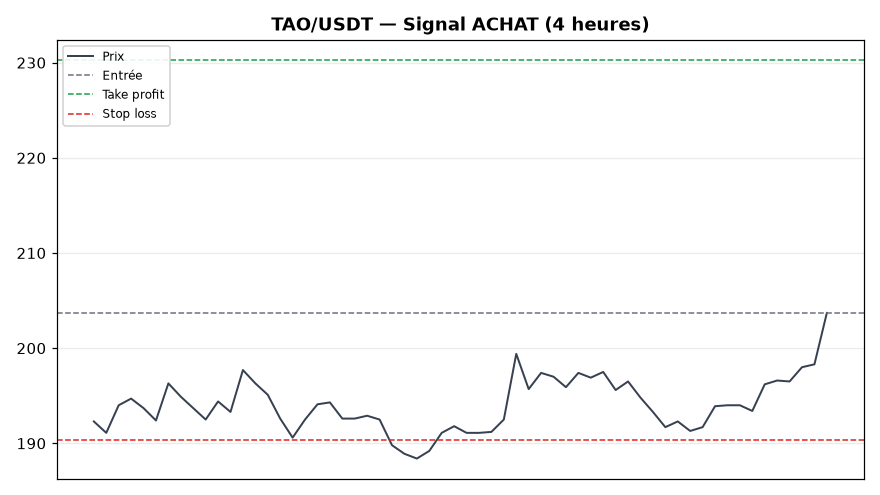
TAO/USDTBUY
Entry203.70Stop loss190.39Take profit230.32
On TAO/USDT, the same ranking principle as relative strength, measured on 4-hour candles: TAO/USDT ranked among the strongest cryptos of the moment. This engine only fires while the market is bearish — the window where the system's other strategies stay silent. Entry near 203.70, stop loss at 190.39 (-6.5%), main target at 230.32 (+13.1%), exit after 3 days. This engine is under observation: its edge measures positive in three years out of four, but declining in the most recent one.
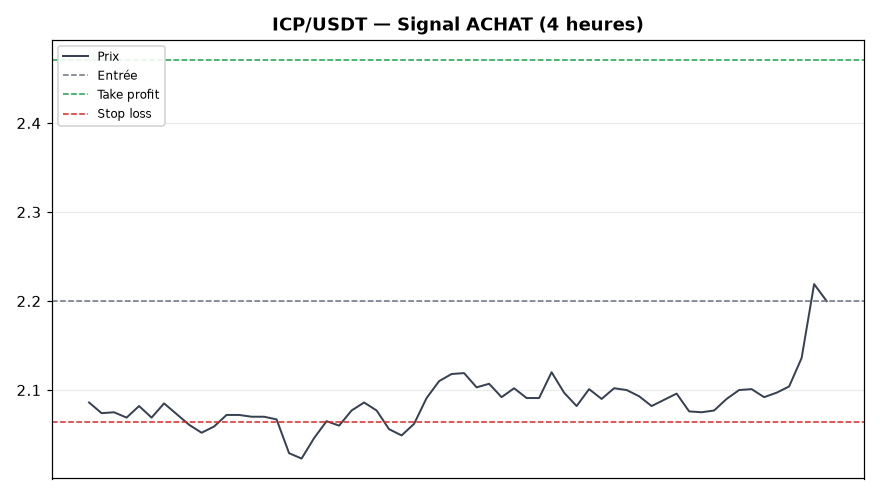
ICP/USDTBUY
Entry2.20Stop loss2.06Take profit2.47
On ICP/USDT, the same ranking principle as relative strength, measured on 4-hour candles: ICP/USDT ranked among the strongest cryptos of the moment. This engine only fires while the market is bearish — the window where the system's other strategies stay silent. Entry near 2.20, stop loss at 2.06 (-6.2%), main target at 2.47 (+12.3%), exit after 3 days. This engine is under observation: its edge measures positive in three years out of four, but declining in the most recent one.
BNB/USDTBUY
Entry592.57Stop loss574.12Take profit629.47
On BNB/USDT, the same ranking principle as relative strength, measured on 4-hour candles: BNB/USDT ranked among the strongest cryptos of the moment. This engine only fires while the market is bearish — the window where the system's other strategies stay silent. Entry near 592.57, stop loss at 574.12 (-3.1%), main target at 629.47 (+6.2%), exit after 3 days. This engine is under observation: its edge measures positive in three years out of four, but declining in the most recent one.
📊 Real performance of past signals
10closed signals
50.0%win rate
5wins
5losses
🔒 3 (30%) secured trades (TP1 reached, break-even or better)
Pair
Type
Result
ETC/USDT
BUY
LOSS
XLM/USDT
SELL
WIN
AVAX/USDT
BUY
WIN
SOL/USDT
BUY
WIN
LINK/USDT
BUY
LOSS
XLM/USDT
BUY
LOSS
NEAR/USDT
SELL
LOSS
CHZ/USDT
BUY
LOSS
DOGE/USDT
SELL
WIN
LTC/USDT
SELL
WIN
Result determined automatically by comparing each signal's current price to its stop loss and take profit (not a tick-by-tick intrabar analysis).
These results may include signals produced by earlier engines, since switched off. They therefore do not describe the four families above, which have no live track record yet. A carry's outcome is not measured on a price but on the funding actually collected, net of fees.
💼 Live performance (paper portfolio)
If a paper portfolio had allocated 10% of its capital to each of the last 9 resolved signals (sent or not), here is its cumulative track record:
+1.5%
📉 Worst cumulative drop observed (max drawdown): 0.3%
⚠️ Illustrative simulation (fixed position sizing, no compounding of gains) — does not reflect a real account or fees/slippage. Not investment advice.
💬 What people say
👍 « Je trouve le bot vraiment très complet. Les signaux sont de très bonne qualité et le rapport qualité-prix est franchement exceptionnel. Pour le prix, c’est vraiment difficile de trouver mieux. »
✅ Real reviews left via /review by subscribers (anonymized).
❓ The awkward questions
In the order they actually come up, starting with the one we would rather skip.
Are most signals winners?
No, and it is measured: the directional engines are right about half the time, and the median signal loses 0.69%. Profitability comes from a minority of large winners.
The consequence matters: you have to take them all. Cherry-picking the ones that “look solid” statistically means keeping only the losing half.
Why do I get nothing for weeks?
Because the market is falling. The engines that buy strength are cut off while Bitcoin sits below its 200-day average — 41% of the time over six years, and up to 381 consecutive days between December 2021 and January 2023.
Two engines keep working meanwhile: funding carry, which does not bet on price, and 4H momentum. The /marche command recomputes that state live, on demand.
What exactly is a “carry”?
You open two opposite positions of equal size on the same crypto: a spot buy and a short on the perpetual contract. They cancel out — if price rises, one gains what the other loses. Market direction no longer affects you.
What you collect is the funding rate: paid every 8 hours by perpetual buyers to sellers. Measured over six years: 84.2% winning positions. It is not risk-free — the short leg can be liquidated, and the worst measured position lost 19.86%.
How do I know the numbers are not dressed up?
Every signal is published before its outcome is known, then closed publicly, win or lose. The full history is on the transparency page, losses included.
Backtests are measured against a control: a random draw of the same density. A strategy that does not beat that control is dropped — which happened to ten of the twelve approaches tested.
What does it cost, and am I locked in?
The trial is 3 days, free, no card. After that the subscription is paid in crypto, one period at a time: no recurring charge, no auto-renewal. If you do not renew, access simply stops, and there is nothing to cancel.
You will see the real cadence, the shape of the signals, and the days with nothing. It is exactly what a subscriber sees — there is no separate “demo” version of the product.
⚠️ This content is provided for informational and educational purposes only, it does not constitute investment advice. Trading cryptoassets carries a risk of capital loss. Past performance does not guarantee future results.